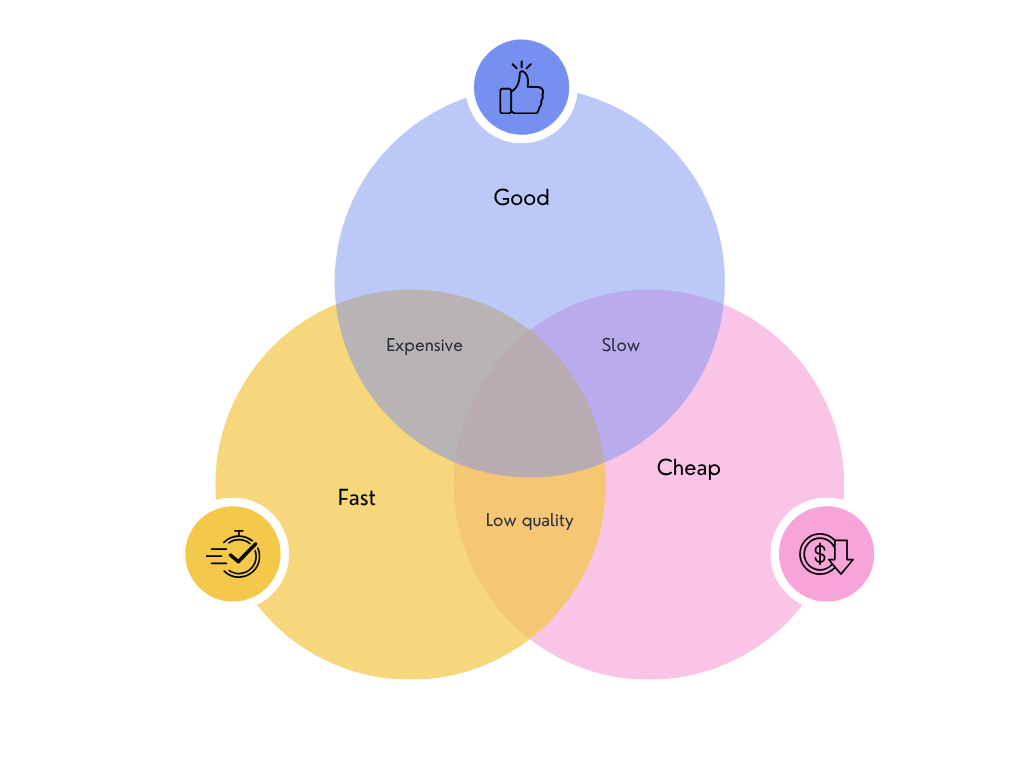
When I was at university (many, many years ago!), I remember one of my lecturers teaching us about the good, fast, cheap triangle. The idea was simple. When choosing a product or service, clients could pick any two, but rarely all three.
It could be cheap and fast, but it probably wouldn't be good.
It could be cheap and good, but you might be waiting a while.
Or it could be good and fast, but it probably wouldn't be cheap.
It's one of those lessons that's stayed with me over the years, both as a consumer and as a business owner, when navigating my own competing priorities and those of my clients.
It almost seems like a no-brainer that good should be non-negotiable. So perhaps the real question becomes, what are we prepared to compromise on?
I've used this analogy more than once in mortgage broking, particularly when talking to clients about choosing a lender. But the truth is, home lending is far more nuanced.
Because while a client might have their ideal lender picked out, whether that lender will choose them in return is often the more significant question!
When your preferred lender swipes left
There are plenty of reasons why a lender might not be the right match for a client, even when that client would happily give them their business.
Let's look at a few.
1. Your deposit or upfront contribution
Generally speaking, the smaller your deposit relative to the property's value, the greater the risk to the lender. Different lenders have different appetites for this risk, and some have stricter limits on how much they're prepared to lend against a property's value.
So that beautifully advertised interest rate might not be available to someone with a smaller deposit.
2. Your ability to borrow and repay
You might think calculating how much someone can borrow would be relatively black and white. Income minus expenses, with a few calculations thrown in. Simple, right? Not quite.
Different lenders assess income, expenses and existing financial commitments in different ways. Some may be more accommodating of self-employed income, overtime, commissions or certain government benefits, while others have policies better suited to someone earning a consistent PAYG salary.
The same client can end up with very different borrowing capacities depending on which lender is assessing their application.
3. The type of property you're purchasing
Believe it or not, lenders can be quite particular about the properties they're prepared to accept as security. Some have restrictions around certain postcodes, high-density apartments, smaller properties or particular types of construction.
And even when two lenders are happy to finance the same property, their valuations may be different. That difference can have a significant impact on the amount you can borrow and the deposit you'll need.
4. Your credit history and repayment conduct
Banks understandably want confidence that the money they lend will be repaid. Your credit history, existing debts and how you've managed repayments can all influence a lender's decision.
A history of missed or late payments might be a dealbreaker for one lender, while another may assess the circumstances differently.
But what if the cheapest lender actually does want you?
Here’s where things get juicy!
Let's say you have a strong deposit, stable income, an excellent credit history and a property that ticks all the boxes. Then you've got options.
Surely from here we just find the lender with the lowest interest rate and lock them in and let’s gooo?! But let’s just slow down a little..
Because although cost is often important, if we go back to our trusty triangle, we know that cheap doesn't always mean good. And even when it does, that doesn't necessarily mean it's good for you.
You might have a bunch of cash and want to keep it in an offset account. Except some lenders charge additional fees or a slightly higher interest rate for loans with an offset account. Maybe you want multiple offset accounts to organise all your spending, bills and budgets. And not every bank will let you do that.
Maybe you want access to a branch, and we all know those are few and far between these days. Or it’s super important for you to have a bloody good banking app, but perhaps the cheapest looks like it hasn’t been updated since 2012!
And for some people, none of that will matter one bit. They'll happily put up with a clunky app or fewer features if it means saving money on their mortgage. Others might be willing to pay a little more for the convenience of having the features and services that matter to them.
Then there's timing. You might have found a lender with a fantastic interest rate, but if you've just purchased a property with a tight finance deadline, you might discover their current turnaround time is eight or more business days just to pick up your file for an initial review (and I’ve seen worse!)
And suddenly, what seemed like a pretty straightforward choice has a few more factors to consider.
Let’s be clear though, I am not at all saying that a more expensive home loan is going to be a better one. Sometimes the cheapest option really is the most suitable, and paying extra for features you'll never use doesn't make any sense!
But as we’ve already seen, things are not black and white.
Two clients with very similar financial circumstances could have completely different priorities, and what one considers essential, the other might not care about at all.
And I love getting to know what is important to my clients. It’s never just about comparing rates. It’s about understanding what matters to someone, exploring the options available to them and helping them understand the differences.
And perhaps that's the part of my university lecturer's lesson that's stuck with me the most. It's not necessarily about getting everything you want.
It's about knowing what's important to you, understanding what you might need to compromise on, and making a decision you're comfortable with.
And if we can find you something good, fast AND cheap along the way?
Well, I certainly wouldn't complain!
Trying to find the right balance for your next loan?
You don't have to figure out lender policies, turnaround times, or offset structures on your own. Let’s look at your unique situation together and find a solution that actually fits your life.